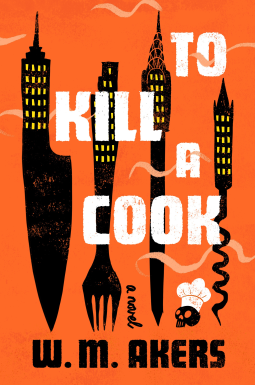
dead men can't cook
It’s 1972, and restaurant critic Bernice Black is working hard to have it all. She works at the Sentinel magazine, writing about restaurants and chefs in New York City. Her nights are spent eating, and her days are spent writing (and sleeping). She is also engaged to Toru, a novelist with two young sons. So she’s also trying to be the best stepmom ever, by helping with school drop-offs and pick-ups. And her fiancé's birthday is coming up, so she’s working hard to perfect her Charlotte Russe for his party.
She decided to come to New York to write about restaurants when she was a kid. She saw a magazine interview with French chef Laurent Tirel, saw photos of his restaurant Laurent and his food, heard about the celebrities who ate there, and she knew she wanted to be there. When she was in college, she saved up her money to take her roommate and herself to his restaurant to try out the French food for herself and ended up having dinner with the chef himself. She considered him a friend ever since.
But the menu Laurent had come up with for Toru’s upcoming birthday party was unacceptable to Bernice. She was wanting some of his old school French (he was one of the original “Butter Boys,” the chefs who moved from France to the U.S. to open restaurants here). What she got was dull and uninspired. Bernice had stopped by the restaurant on her way to the magazine to talk to him about it. She let herself into the restaurant, and what she found stopped her in her tracks.
Bernice started yelling for Laurent as soon as she got in. She didn’t see him anywhere, and he didn’t answer. She made it to the kitchen, where a perfect stock sat on the stove, reduced to the point it would be perfect for aspic. So she checked the refrigerator, and that’s where she found the famous chef. Or part of him anyway. His head was preserved in a perfect aspic.
After calling the police and getting questioned by detectives, Bernice realized that she would have to find Laurent’s killer herself. Not just any chef could create such a perfect aspic, a jellied dish that takes a lot of skill. Bernice knows that she has the unique understanding of chefs and food to figure out who could have done that, and she is determined to find out who killed her friend. As she follows clues through the restaurant scene of New York City, she finds great food, big personalities, shady characters, sex, drugs, alcohol, and a much needed toothpick flag of Andorra. But will she find the answers she’s looking for before the killer tries to cook her goose?
To Kill a Cook is a creative murder mystery that brings 1970s New York City to life, with all its artistry and its depravity. From the smaller family restaurants to the upscale restaurants with lines of limousines out front, this story ran me all over the city and made me hungry for all sorts of food. This is not a book for those with delicate sensibilities. There is no hiding from the blood and guts of cooking, or of murder.
I love to read about the history of American cooking, so I was fascinated by everything in this story. I loved the restaurants, the chefs, the dishes. But this was also a smart, well-plotted mystery, if you’re just here for the whodunnit. And on top of that is the struggle of Bernice in her personal life, where she is trying to be a good stepmother while being good at her job as well as struggling with her attraction to women. She has a lot to juggle, which felt genuine to me, especially for that time. I loved that she had a strong voice, she wasn’t afraid to hold others accountable for their actions, and she took responsibility for her shortcomings. She was a strong character, and I loved being with her through this story. Her intelligence and her heart make this story.
Egalleys for To Kill a Cook were provided by Putnam through NetGalley, with many thanks, but the opinions are mine.